Bunny Shield identifies automated traffic using behavioral fingerprinting, header anomalies, and IP reputation. Detection rules and sensitivity profiles propagate across the edge within seconds, so policy changes take effect in near real time.
Key Features
- Behavioral Fingerprinting: Distinguish real users from automated traffic using fingerprinting, header anomaly detection, and request behavior modeling.
- Real-Time Response: Detection logic and mitigation rules propagate across the edge within seconds, so policy changes take effect almost immediately.
- Customizable Rules: Set detection conditions based on HTTP headers, IP reputation, user-agent anomalies, cookie presence, request frequency, and other signals.
- False Positive Resistant: Allow-listing, ASN validation, and crawl integrity filters keep legitimate crawlers and automation from being blocked.
Multi-layer request analysis
Every request that reaches Bunny Shield is evaluated through multiple layers of analysis, each targeting a different way automation tries to hide:
- Request integrity checks analyzes headers, query structures, and protocol patterns to detect spoofed or malformed requests.
- Request body inspection for applicable methods, which will inspect payload structure and behavior to spot signs of scripted abuse.
- External intelligence uses IP and ASN reputation, rate patterns, and global behavior history to flag known abuse sources.
Sensitivity profiles
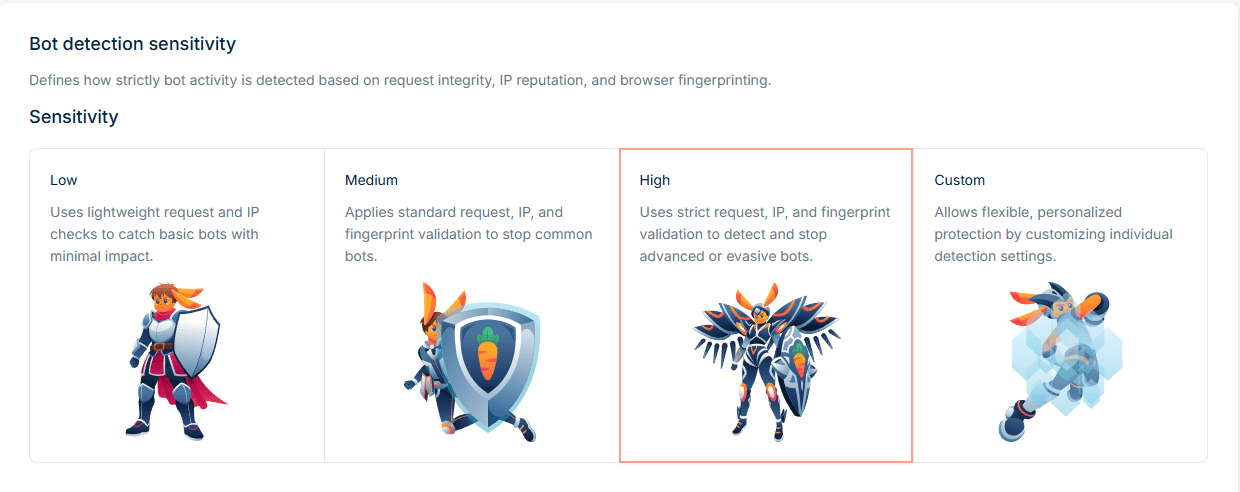
You can choose from predefined detection profiles, each tuned to different use cases:
- Low (default) catches basic bots with minimal overhead using lightweight IP and header analysis.
- Medium applies balanced checks across IPs, headers, and fingerprint signals to detect common automation.
- High enables strict fingerprint validation, request integrity analysis, and IP behavior scoring to stop advanced or evasive bots.
- Custom lets you configure individual detection components for total control.
Granular detection toggles
With Custom mode enabled, you can adjust:
- Request integrity looks for anomalies in headers, protocol usage, and request structure.
- IP address scores requests based on IP reputation, behavior, and known rate patterns.
- Fingerprint sensitivity determines how assertively Bunny Shield should treat unusual browser fingerprints as bots.
- Complex fingerprinting (Business or above) combines advanced entropy analysis and cross-session consistency.
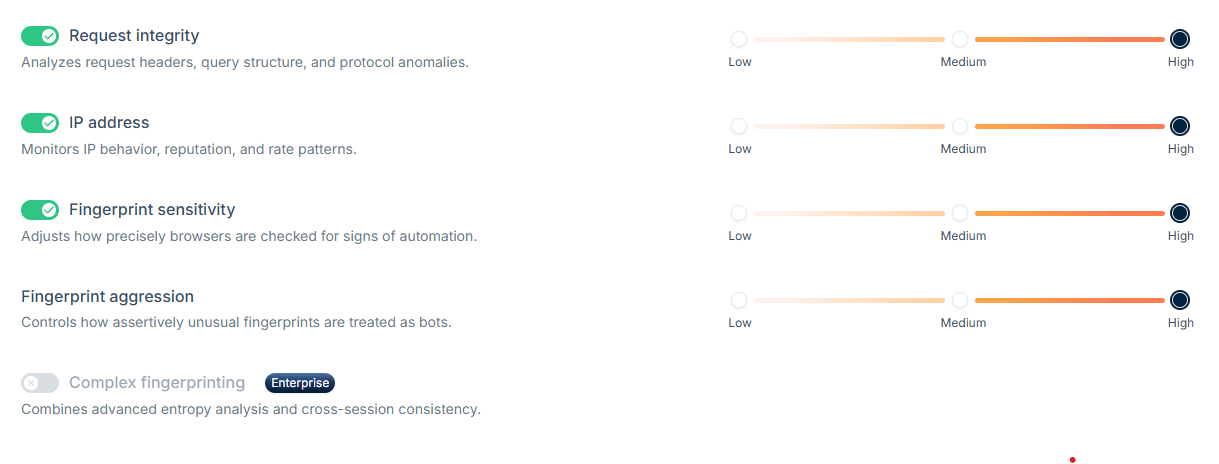 These options let you tailor detection to match your traffic profile and risk tolerance. And with Edge Rules, you can disable bot detection dynamically based on headers, cookies, IP addresses, or specific endpoints, giving you full control over when and where protection applies.
Logging & Observability
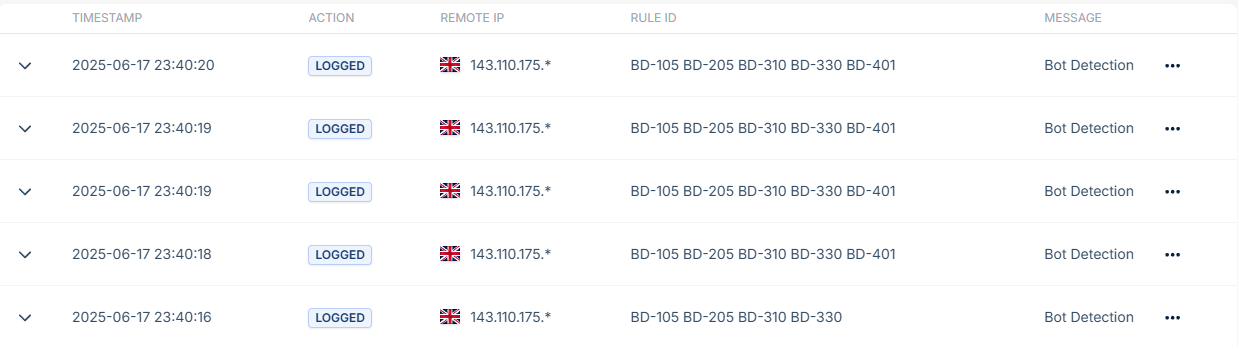
Bot detection isn’t a black box. Bunny Shield shows you exactly what it’s seeing and doing, in real time:
- Logged requests: Number of requests identified as bots but not challenged.
- Challenged requests: Number of requests that triggered browser validation. We give you the full picture, with clear metrics and event logs that show what’s being flagged and how it’s being handled. No guesswork required.
Configuring via API
You can utilize the Bunny Shield API to automate Bot detection configurations or integrate them into your continuous integration and continuous deployment (CI/CD) pipelines. This capability allows you to manage your security settings efficiently and consistently across different environments. Last modified on June 15, 2026

